



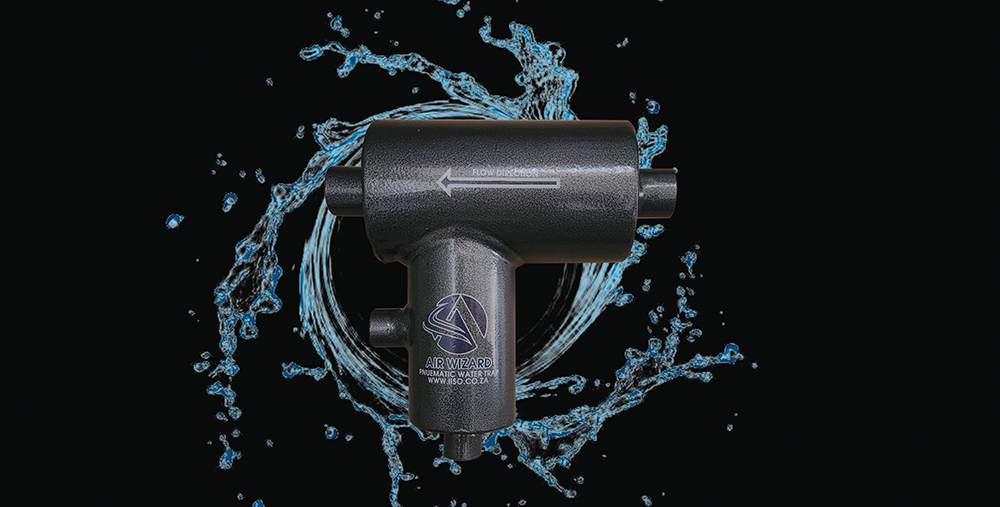
ISO-Reliability Partners has taken another step in bringing to market highly effective solutions to combat contamination in all its forms. The locally designed and patented Air Wizard inline water trap is proudly manufactured in South Africa. It has been SABS tested for the separation of water, oily fluids, rust and solid particulates from pneumatic compressed air or gas lines.
“Anyone operating a compressor understands the ongoing problems associated with water and contaminants in compressed air lines,” says ISO-Reliability Partners CEO, Craig Fitzgerald. Air Wizard is a solution for compressed air treatment that efficiently removes water and solid particulate matter without any need for servicing, maintenance or consumable costs. It is fitted with a unique patented condensate drain mechanism that allows for the collection and removal of condensate, oil, rust and any other foreign particle from the flow path, without unnecessary air loss during the automated purge and discharge cycle.
“Our homegrown solution to clean compressed air is highly efficient, effective and consumable-free,” explains FitzGerald. The Air Wizard extracts about 97% of free water in the system, which reduces corrosion, and protects tools, air motors, instruments and other equipment being driven by compressed air. The product has been SABS pressure tested to over 1200 kpA. The pneumatic water trap passed SABS efficiency tests with an average 96,85%. “Air Wizard is the most effective solution available to industry, and incurs zero operational or maintenance costs,” he adds.
Condensation is a byproduct of the air compression process. This moisture affects the entire system, including piping and connections. The quantity of water generated in an air compressor depends mainly on the ambient air quality, humidity levels, operating pressure and inlet condition. Air temperature, humidity, compressor size and operating pressure determine the amount of water that will collect in the air tank.
Condensation and particulate matter in a compressed air reservoir cause debris to accumulate within the air circulation system. This water coalesces with other solid impurities like dirt and oils, and damages cylinder and valve systems.
These mixtures can narrow airflow tracts and dry out lubrication on machinery parts, slowing down production speeds. Further, compressed air contamination can damage rubber components of equipment valves, causing them to stiffen, or even rupture.
To counteract this, numerous high-maintenance accessories exist in the market, including condensation separators, aftercoolers, refrigerant dryers, and adsorption dryers. These have varying degrees of efficiency, with the associated maintenance and service costs.
As water is the predominant contaminant found in compressed air systems, the focus has always been on water removal. However, many other contaminants are found in air systems that are not removed by these accessories. These include micro-organisms, oil vapour, atmospheric particulates, dust, rust, and pipe scale. “Air Wizard stands apart not only due to its affordability, but also through the removal of all foreign particulate matter,” adds FitzGerald.
Moisture is highly problematic for pneumatic systems, instruments, air motors, actuators, valves, and air-powered tools. In addition, any components or machines connected to the pneumatic system are impacted, resulting in potential contamination or quality variances of the end product. Adverse effects of pneumatic system contamination are excessive maintenance, shorter equipment life, corrosion and rust within the piping system and equipment, and damage to pneumatic controls. In cold weather, freezing can damage control lines.
Precision instruments are particularly affected by system contaminants, resulting in regular unnecessary replacement. Quality defects in finished products are a key concern in the food manufacturing industry in particular. Pneumatic systems are used to manufacture, dry. and seal packaging for perishable foods, making end-product quality an essential requirement. Here the presence of condensation in a compressed air system can have serious consequences. If impurities from the compressed air enter packaged food items, there will be a significant alteration in the quality, potential bacterial contamination, and reduced shelf life of the finished products.
FitzGerald emphasises that implementing the necessary steps to keep compressed air dry, clean and suitable for your application is highly recommended. “ISO-Reliability has just made that process so much easier with its innovative Air Wizard automated pneumatic water trap,” he says. “The solution is a simple addition into existing lines to reduce load on existing accessories immediately, lowering maintenance costs and mean time between servicing.
For more information contact Craig FitzGerald, ISO-Reliability Partners,






© Technews Publishing (Pty) Ltd | All Rights Reserved

 printer friendly version