


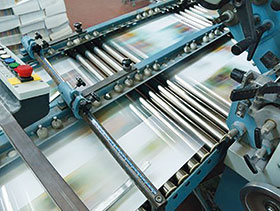
Whether it’s for actual printing press machinery or supplementary systems, such as inserters, reel stands and cart loaders, many in the print industry are taking steps to replace DC drives with AC drives in a number of core processes. The latest variable speed AC drives offer advantages that include an attractive price-to-performance ratio. For example, matching a variable frequency drive with a high-efficiency asynchronous motor as part of a complete three-phase main drive on an offset printing press will yield many benefits, not least high performance and reduced energy consumption. However, there are more factors to consider here. Take compatibility for instance. Many print shops will have an entire range of DC drives employed by their machinery, which are considered the driving backbone of the presses. So when beginning a transition project to AC drives, always check for complete compatibility between the two.
Further factors to check include Ethernet and EtherCAT interfaces, as well as the availability of various optional modules and interface units that allow the drive to integrate seamlessly with existing systems. Such modules might include those offering feedback, communications, applications (onboard PLCs), I/O and enhanced safety functionality.
When selecting suitable AC drive technology, ensure it has onboard real-time Ethernet and can provide high-level motor control. Ultimately, any drive for print industry applications should be capable of optimising system performance, ideally through integrated motion control for 1,5 axes. This is vital for high speed, round-the-clock operations, such as printing shops.
To ensure superior motor control, engineers should seek out drives with high bandwidth algorithms to suit various motor types. This enables maximum machine throughput in every application and with every motor, from standard closed-loop induction motors to dynamic linear motors, and from energy saving permanent magnet motors to high-performance servo motors. Furthermore, flexible speed and position feedback interface can support a wide range of feedback technologies from resolvers to high resolution encoders.
Inherent drive flexibility should also help design engineers looking to create centralised and decentralised control systems as required, while versatility can be assured by AC drives offering Safe Torque Off (STO) functionality and both analog and digital I/O.
Another common reason why printing shops are seeking out the latest AC drive technologies is the obsolescence of existing drives. In such instances there exists real opportunity not just to avoid any potential for production downtime, but upgrade to AC drives offering compact dimensions, a flexible interface and an in-built PLC; perfect for machines such as inserters, which feature a lot of rotating equipment and fast-moving grippers.
For inserters, motion has to be perfectly synchronised, which is where the on-board PLC comes into play as it eliminates the requirement for I/O. However, check that programs are fast and easy to develop, and ensure the software is user-friendly and conforms to industry standard IEC 61131-3 programming languages. This way it will be possible to build highly flexible and productive systems.
Of course, open-platform technology should be at the heart of any successful drive solution. With this in mind, check that the drive supports a wide range of industry standard technologies and protocols, not just IEC 61131-3, but open fieldbuses and networks including Ethernet/IP, EtherCAT, Profinet and Profibus, as well as Ethernet protocols including PTP protocol for clock synchronisation to IEEE 1588 V2. This open approach provides significant benefits to machine builders and OEMs, as well as engineers and end-users who many want to expand the system in the future.
Compatibility is again a prerequisite with inserters in order to avoid excessive machine hardware changes and code modifications to the controller. A high degree of compatibility also streamlines the replacement process into a short period of time. Further benefits for busy print shops include a flexible interface on the AC drive. This design capability allows printers to use different Profibus modules or different encoders, for example, thus simplifying communication with other equipment. Also, the interface can determine what motor is deployed and link to it immediately, which means print shops are not restricted to using one motor type.
The demands placed on modern printing machines are increasing almost continuously. Today’s print shops are looking to maximise performance, print quality and machine availability (uptime), while at the same time reduce scrap and waste. This is why increasing numbers are turning to technology suppliers with industry-leading know-how of drive and automation solutions, in particular AC drives.
For more information contact Ryan Chetty, Nidec Industrial Automation Southern Africa, +27 (0)11 462 1740, [email protected], www.nidecautomation.com
| Tel: | +27 11 462 1740 |
| Fax: | +27 11 462 1941 |
| Email: | [email protected] |
| www: | www.controltechniques.com |
| Articles: | More information and articles about Nidec Industrial Automation Southern Africa |






© Technews Publishing (Pty) Ltd | All Rights Reserved

 printer friendly version