



Robotic manipulation refers to a variety of processes such as moving an object, grasping, dropping, carrying, and many others. Essentially, manipulation helps in performing repetitive tasks with less complexity. At present, the technology is moving towards designing advanced manipulators with improved performance and simulated thought process to function in unstructured environments.
Robotic manipulation refers to a variety of processes such as moving an object, grasping, dropping, carrying, and many others. Essentially, manipulation helps in performing repetitive tasks with less complexity. At present, the technology is moving towards designing advanced manipulators with improved performance and simulated thought process to function in unstructured environments.
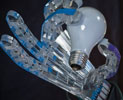
Recently, a team of researchers at the Robotics and Mechanisms Laboratory (RoMeLa) at the College of Engineering in Virginia Tech have been successful in developing a robotic hand capable of performing intelligent manipulation of a variety of objects, based on its textural qualities. The robotic hand named, RAPHaEL (robotic air powered hand with elastic ligaments) is powered using a compressed air tank in combination with an accordion type of tube actuator. Coordination of finger movements is controlled using microcontroller commands.
The uniqueness of the robotic hand is its air-powered design, which obviates the need for using motors or actuators. Each of the joints within the hand is controlled using a single corrugated tube actuator, which makes RAPHaEL extremely light-weight compared to other robotic hands in existence.
Overall, the design facilitates easy adjustment of the compliance and grasping force of the hand, through simple change of air pressure. Hence, the gripping force of the hand is determined by the amount of air pressure exerted in the design. The design also permits the fingers to naturally adhere to the contour of the object to be manipulated.
Frost & Sullivan believes that RAPHaEL could even find application prospects in robotic prosthetics, if the hand is found to be safe as well as simple in operation.
The hand does not incorporate any kind of artificial muscles or tendons. Instead, each of the fingers is made out of inflatable tubes, which, upon inflation, result in the curling of finger towards the object to be grasped. Upon contact with an object, even more air pressure is supplied to enable generation of sufficient friction in the fingers for picking up an object. The compliance changes induced by the air pressure thus allow the hand to manipulate even delicate objects such as eggs or light bulbs as well as rigid objects such as food cans.
RAPHaEL is a part of a large humanoid robot project named CHARLI (cognitive humanoid robot with learning intelligence). It is envisioned that, connecting the hand to the robot would facilitate easy grasping, holding, and picking of various objects in place.
For more information contact Patrick Cairns, Frost & Sullivan, +27 (0)18 464 2402, [email protected], www.frost.com






© Technews Publishing (Pty) Ltd | All Rights Reserved

 printer friendly version